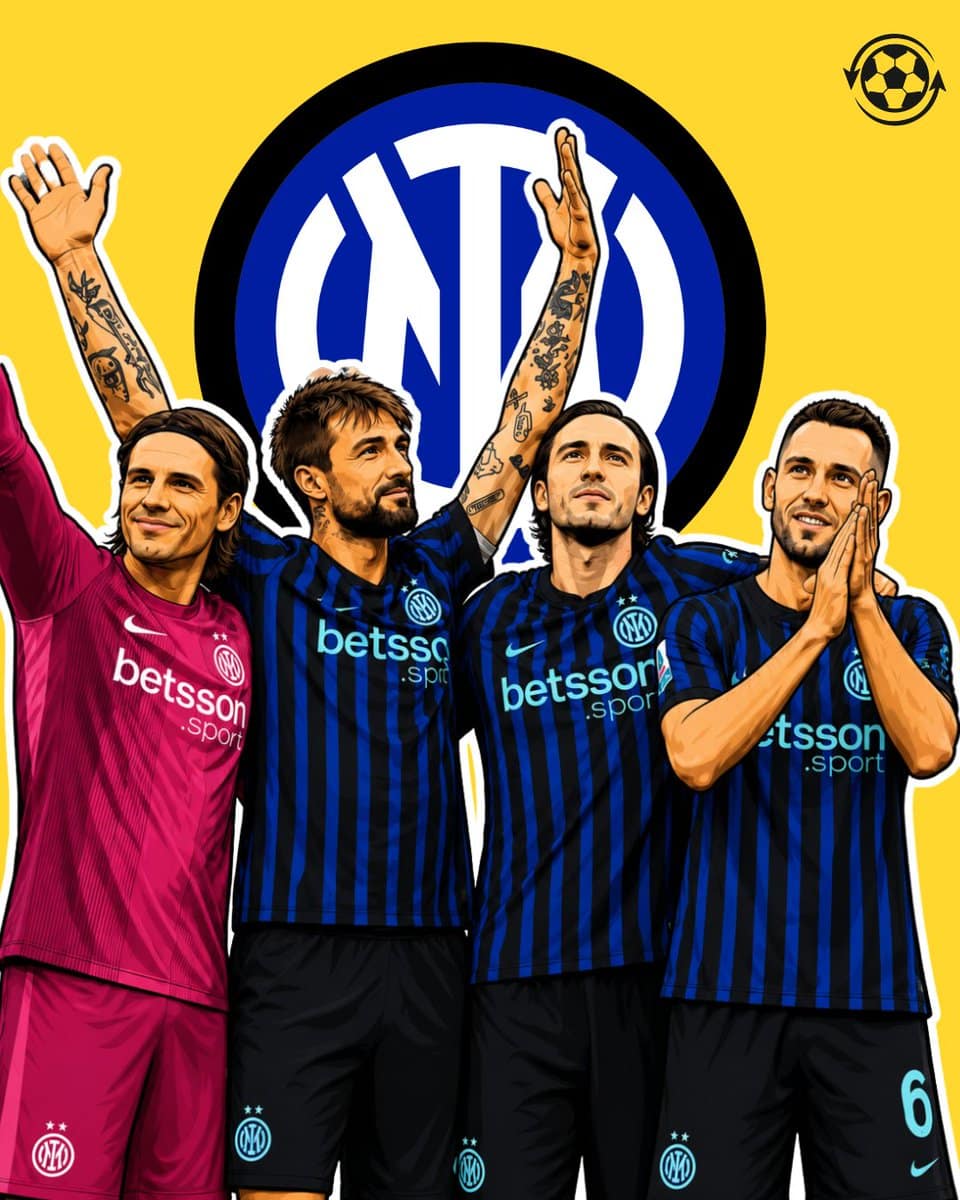
Inter Milan’s decision to release four veteran defenders in a single day wasn’t a break from the past season — it was the conclusion of one. The real test isn’t the farewell. It’s whether Oaktree is willing to fund what comes next.
Inter Milan didn’t lose four players on July 1. It confirmed something that had already happened.
Yann Sommer, Francesco Acerbi, Matteo Darmian and Stefan de Vrij left as free agents, closing out a combined 801 appearances and eight years of continuous service from De Vrij alone. On paper, it reads like a mass exodus. In practice, it was closer to a formality.
By the second half of last season, three of the four were already fading from the rotation. Chivu had been quietly building his succession plan in real time, handing minutes to younger options while the veterans watched more matches than they played. The Scudetto that followed — Inter’s 21st, paired with a Coppa Italia — was won by a squad already mid-transition, not one still relying on its oldest names to get there.
That’s the part of this story getting lost. The transition wasn’t announced this week. It was completed last season, and it worked.
A Team That Was Already Changing
Sommer was the exception. He started consistently until the end, and his exit leaves the most immediate hole of the four — though Josep Martinez, who impressed in relief appearances during the campaign, gives Inter internal cover in a way the other departed positions simply don’t have.
Darmian and De Vrij, by contrast, had already been eased out of the picture well before their contracts expired. Their departures confirm a shift that had been underway since at least the winter, not a sudden decision made in a boardroom this summer.
Acerbi is different, and this is where the conversation about these exits tends to miss the point. He played a significant share of minutes right up until the end, and unlike the others, Inter doesn’t currently have a like-for-like replacement waiting in the squad. If that gap isn’t addressed properly this window, it won’t be De Vrij’s absence Inter feels first. It will be Acerbi’s — a physical, vocal center-back whose reading of the game anchored a defense that had otherwise been aging out of its prime.
Fans fixating on Sommer’s exit as the biggest loss are arguably looking at the wrong position. Goalkeeper has succession planning in place. Center-back, at the moment, does not.
 Timing, Not Just Personnel
 Timing, Not Just Personnel
There’s a fair argument that these exits should have happened twelve months earlier. Inter had been one of the older squads in the Champions League for multiple consecutive seasons, and age caught up with the group in moments last term — visible in stretches where legs slowed before substitutions arrived.
But there’s also a case that doing it all at once, now, is the correct call precisely because it removes the option of delay. Staggering these departures across two transfer windows would have let the club keep leaning on aging cover a little longer, the way it has in recent summers. Cutting ties with all four simultaneously forces the issue. Inter has no choice now but to build a younger core, because the alternative — patchwork depth stitched together from players in their mid-to-late thirties — no longer exists as a fallback.
That’s a healthier position than it looks on the surface. A club that keeps extending veterans by another year eventually stops being able to compete for anything beyond survival in Europe. Inter avoided that trap by forcing the transition rather than drifting into it.
The Real Risk Isn’t the Exits — It’s the Budget Behind What Replaces Them
This is where the story stops being about four departing defenders and starts being about the club’s ownership.
Oaktree has set a transfer budget of roughly €50 million this summer, supplemented by outgoing sales such as Hakan Calhanoglu’s. Set against the scale of what’s required — a starting center-back, senior goalkeeper depth, and possibly a midfield addition — that number looks less like discipline and more like a ceiling that doesn’t match the club’s stated ambitions.
Last season should have settled this debate. Inter reached a Champions League semifinal on a squad that had already been quietly reshuffled by Chivu, not because the roster was fully resourced, but because the coaching staff extracted more from less. That’s a credit to Chivu’s man-management, not evidence that the model is sustainable. Teams that treat continental competition as an achievement in itself, rather than something to be actively resourced year over year, tend to discover the gap the hard way — either dropping out of contention entirely or making the field just to be eliminated early. Serie A has recent examples of both outcomes, and none of them are results Inter should want to risk repeating.
If this rebuild stalls in its first year, the accountability shouldn’t land primarily on Chivu or on Ausilio’s negotiating position. It should land on the size of the budget they were given to work with. Chivu already proved what he can do without full resources last season. The question this summer is whether Oaktree is willing to invest enough to make sure that talent isn’t operating with one hand tied behind it again.
What This Actually Means Going Forward
The four exits aren’t the story anymore. They’re the closing chapter of a transition that began last season and delivered a title anyway — proof, if anything, that Inter’s younger core is more ready than the farewell tributes suggest.
The real story is what Oaktree does next. A club with Inter’s recent European pedigree doesn’t stay competitive by managing decline carefully. It stays competitive by reinvesting at the level its ambitions require. Whether this rebuild becomes the foundation for another sustained run at Europe’s biggest trophy, or a cautionary tale about mistaking thrift for strategy, depends less on Chivu’s ability to coach than on whether the club backs him with the resources to finish what last season already proved was possible.
Where do you think Inter’s rebuild is headed — a sustainable new core, or a club underestimating what it takes to stay near the top of Europe?