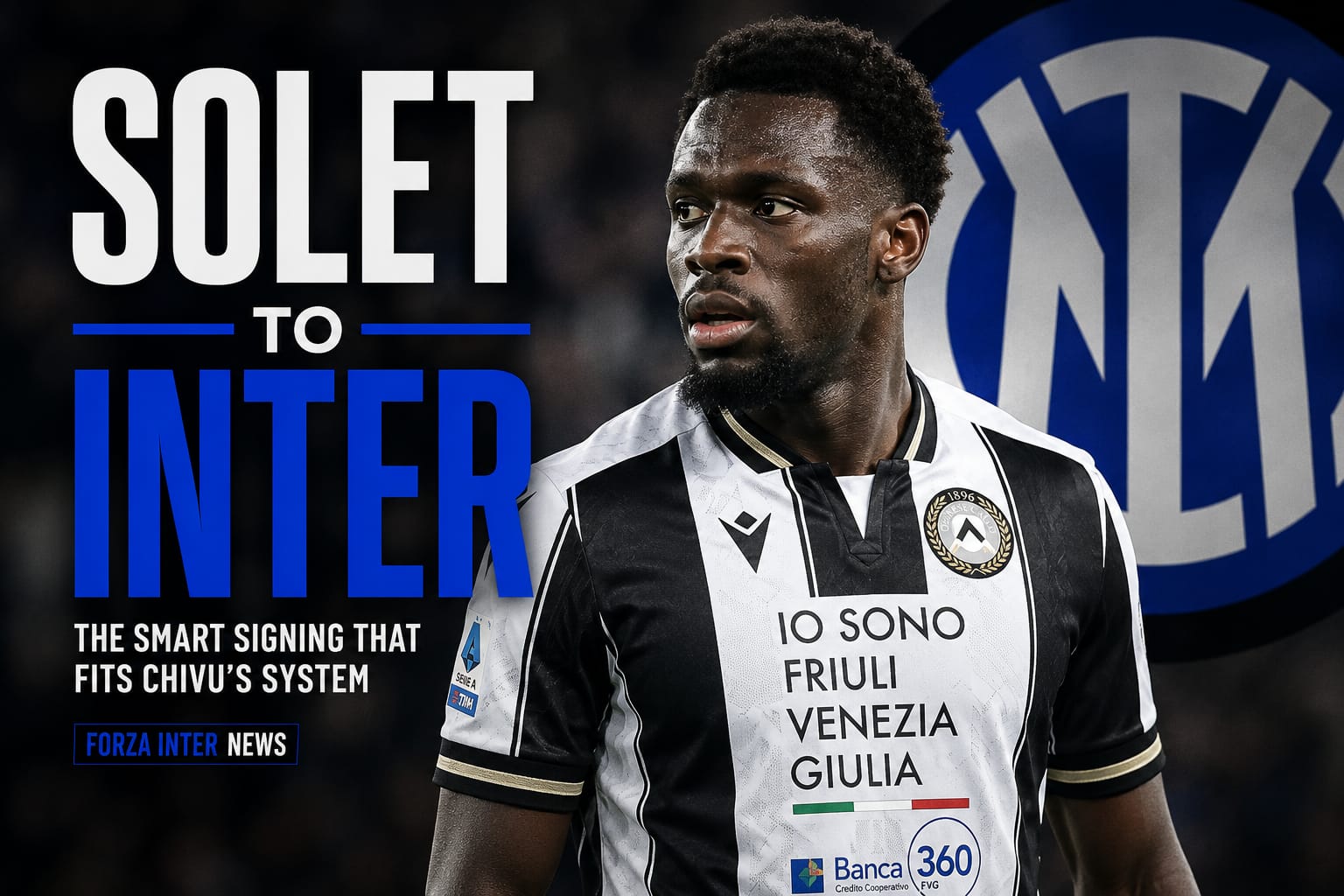
Inter don’t just need defensive depth. They need a specific profile they currently lack. Oumar Solet is that profile — and Chivu’s high press makes him essential, not optional.
Most transfer conversations start with a gap. A player leaves, a club fills the space, and life goes on.
This one’s different. Inter aren’t replacing anyone with Oumar Solet. They’re filling a hole that’s existed all season — one that nobody left, because nobody on the current roster ever covered it in the first place.
That distinction matters. And it’s the whole reason this deal should happen quickly.
A Profile Inter Don’t Have
Look at Inter’s current centre-back options. Acerbi, de Vrij, Bastoni, Bisseck, Pavard. All excellent in their own ways. None of them are Solet.
Solet is quick. He’s athletic. He’s comfortable carrying the ball out of defence under pressure. And critically, he can play both as a left-sided centre-back and through the middle of a back three.
The numbers back up the eye test. Solet isn’t just an athletic defender — he’s one of Serie A’s most active ball-playing centre-backs. Last season he averaged nearly 63 passes per match with an 89% completion rate, while also ranking among the league leaders for interceptions. He completed almost 70% of his dribbles and regularly carried the ball forward from deep areas. In other words, he doesn’t just defend. He helps build attacks. That’s exactly the type of profile Inter currently lack in their back line.
Inter don’t have that profile right now. They have organisers. They have ball-players. They have experienced defenders. What they don’t have is a defender who combines genuine recovery speed, proactive defending, and progressive ball-carrying in one package.
Therefore, signing Solet isn’t about replacing Acerbi or de Vrij. It’s about adding something Inter simply don’t possess.
 Why Chivu’s System Makes This Profile Essential
 Why Chivu’s System Makes This Profile Essential
Here’s where the tactical picture gets interesting.
Chivu is expected to push Inter toward a higher press next season. We’ve already seen the early signs of it — a more aggressive defensive line, higher turnovers, more vertical football.
However, a higher press comes with a cost. It leaves space behind the back line. And exploiting that space requires recovery speed.
Inter‘s current defenders are excellent positionally. But pace isn’t their strength. Against teams that can play balls in behind, that gap becomes dangerous — especially in the Champions League, where Inter’s pressing already came under strain against Arsenal and Bodo/Glimt.
Solet changes that calculation. His speed lets him cover ground that Inter’s current centre-backs simply can’t. Meanwhile, his comfort carrying the ball means he doesn’t just defend the space — he helps Inter transition out of it quickly, which is exactly what a high-press system needs from its back line.
In other words: this isn’t a luxury signing. It’s the missing piece that makes the system Chivu wants to play actually function properly.
The Counterargument: “Inter Need a Natural Centre-Back”
Some fans will push back here, and it’s worth addressing directly.
Bastoni already owns the left-sided centre-back role. He’s arguably the best in the world at it. So why sign another player who can operate there?
It’s a fair point. Inter probably do need a natural, central defensive presence too — someone built primarily to defend the middle of the back three, rather than carry the ball from the left.
However, that argument shouldn’t stop Inter from signing Solet.
Here’s why. Versatility isn’t a downside — it’s protection. A player who can cover multiple positions gives Chivu more options across a long season with three competitions. Solet doesn’t have to start every week on the left. He can rotate through the back three, cover for Bastoni when needed, or anchor the middle when Acerbi-types are unavailable.
Instead of viewing this as either/or, Inter should view it as both/and. Sign Solet now. Pursue a more central, defensively-focused option separately, if and when the right one becomes available.
The two signings solve different problems. There’s no reason solving one should mean ignoring the other.
 The Bigger Issue Fans Are Overlooking
 The Bigger Issue Fans Are Overlooking
Here’s what should really worry Inter supporters: depth.
Acerbi is probably leaving. De Vrij’s future remains unresolved. Darmian — while not a centre-back by trade — adds further experience to the list of potential departures. Our breakdown of Inter’s summer exits covers this in full.
Add it up, and that’s a significant chunk of defensive experience potentially walking out the door in one window.
Inter’s biggest defensive problem next season may not be replacing experience. It may be replacing athleticism.
Meanwhile, Inter are still competing on three fronts next season. Serie A. Coppa Italia. Champions League. That’s a brutal schedule, and defensive injuries or suspensions are inevitable across 50+ games.
Therefore, signing just one centre-back this summer might not be enough — regardless of how good that signing is. Solet should be the first arrival, not the only one.
Ultimately, Inter need both quantity and quality at the back. Solet provides quality and a profile they currently lack. But the depth question remains open, and ignoring it would be a mistake.
What to Expect Early On
Let’s be realistic about the adjustment period.
Udinese play very differently from Inter. They sit deeper, defend in a more reactive shape, and ask less of their centre-backs in terms of building play under sustained pressure.
Inter dominate possession. They defend higher up the pitch. The tempo, the spacing, the decision-making demands — all of it will be a significant step up for Solet.
So, expect some early mistakes. A few positioning errors. Maybe a rough month or two as he adjusts to a back line that’s expected to control games rather than react to them.
Still, there’s good reason for confidence here. Solet already knows Serie A. He understands Italian football’s physicality and tempo, even if Inter’s specific demands are different from Udinese’s.
Because of that foundation, I’d expect him to settle in relatively quickly once the early adjustment period passes. The tools are there — pace, technique, versatility. It’s a matter of re-calibration, not a fundamental skills gap.
 Why This Matters for Inter
 Why This Matters for Inter
This is bigger than one transfer.
Chivu’s system has a clear identity: high press, ball-dominant, vertical when possession is won back. Inter’s tactical evolution under Chivu already showed glimpses of this last season, and the early results were promising.
However, that identity has a vulnerability — pace in behind the back line. Solet doesn’t just add a good player. He addresses a systemic weakness that could otherwise undermine everything Chivu is trying to build.
Combine that with Inter’s looming depth crisis at centre-back, and the case becomes even stronger. This isn’t a “nice to have.” It’s a “need to have, and need to have more than one.”
What Happens Next
Reports suggest Inter and Udinese remain a few million apart on Solet’s fee, with a loan-plus-obligation structure reportedly under discussion as a possible bridge.
If that gap closes — and there’s reason to think it will — Inter should move immediately. Not because the price is unbeatable, but because the profile is rare, the system fit is obvious, and the depth situation only gets more urgent as the summer goes on.
Inter’s summer rebuild tracker will be following this closely. But here’s the bottom line: if the opportunity to sign Solet is real, Inter shouldn’t hesitate. Versatile, athletic centre-backs who already understand Serie A don’t stay on the market for long — and Chivu’s system needs exactly what Solet offers.
Inter should get it done now. This is the kind of deal that looks small in June and looks essential by November.